How Kentucky newspapers wrote about Melungeons
Kentucky newspaper mentions from 1895 to 2018, set beside the laws, court cases and moves that show how Melungeon and related families were classified and treated, from 1691 to 1943.
The newspaper entries come from searches of two free newspaper archives: Chronicling America at the Library of Congress, which covers many Kentucky papers, and the Digital Archives of Johnson County, which covers the Paintsville Herald and the Big Sandy News. Paid archives such as Newspapers.com have not been searched yet, so there are surely more stories to find.
This page also lists the laws and court cases that explain why a racial label could cost a family the vote, a school place or an inheritance, and documented moves by families in the same position. They come from Virginia, North Carolina, Tennessee and Kentucky, because the families moved among them. Each entry has a label: Kentucky newspaper Law Court case Petition Migration. Law, court and migration entries cite statutes, court opinions and scholarly or archival sources, listed with the numbers L1 to L24 at the bottom of the page. A move is included only when a source describes it; where a source does not say why families moved, the entry says so. Where a story repeated online is disputed or has no record behind it, the entry says that too. Laws that applied to “negroes” and “mulattoes” are listed because Melungeon and related families were often counted in those groups, not because the records say every family was.
- Laws and court cases before the first newspaper item
- 1691 Law · VirginiaVirginia passes “An act for suppressing outlying slaves.” It aims to prevent “that abominable mixture and spurious issue” that came from “negroes, mulattoes, and Indians intermarrying with English, or other white women.” A free white man or woman who married a “negro, mulatto, or Indian” was to be “banished and removed from this dominion forever” within three months. The same act forbade freeing any “negro or mulatto” unless the owner paid to send the person out of the colony within six months. It is an early Virginia law that made marriage across the color line a crime.L1
- 1723 Law · VirginiaVirginia passes a law “for the better government of Negros, Mulattos, and Indians, bond or free.” The Crown’s lawyer described one paragraph this way: “no free Negro, Mulatto or Indian whatsoever shall have any vote at the Election of Burgesses or any other Election whatsoever.” Asked in 1736 why the Assembly did it, Governor William Gooch said a slave conspiracy had just been discovered and free people of color were suspected of taking part, although “there could be no legal Proof.” The law, he wrote, was meant “to fix a perpetual Brand upon Free-Negros & Mulattos.”L2
- 1794 Law · TennesseeThe territorial law under which Tennessee was governed (Act of 1794, chapter 1, section 32) bars “all negroes, indians, mulattoes, and all persons of mixed blood descended from negro or indian ancestors to the third generation inclusive, though one ancestor of each generation may have been a white person, whether bond or free,” from testifying in court except against one another. In 1858 a Johnson County, Tennessee, judge told a jury this meant a person with one-eighth African or Indian ancestry was a “free person of color.” The 1835 voting rule in Tennessee used the same line.L3
- 1831 Law · TennesseeTennessee’s Public Acts of 1831, chapter 102, require a freed slave to leave the state and make the owner post a bond for the removal. The act also says it is unlawful for any free person of color “to remove himself to this State to reside therein, and remain therein twenty days.” The law was used in court (see 1838 and 1852).L4
- 31 October 1833 Petition · TennesseeJohn, Andrew and Mark Nickens of Wilson County swear before a justice of the peace in Davidson County that their parents, William and Frances, were “Portugees” from Portugal. They ask the General Assembly for a special act to place them and their brothers and sisters “on a perfect equality with other citizens of the State of Tennessee.” The petition admits their “colour is rather of the mixed blood by appearance and as they are refused many of the privileges of citizenship which they think they are entitled to.” The petition was rejected. The researcher who transcribed it says the Portugal claim is contradicted by the supporting papers filed with it. The Tennessee Encyclopedia notes that after the Civil War some persons of color commonly claimed Portuguese blood as they sought to escape oppression as African Americans.L5
- 1834–1835 Law · TennesseeA convention that met in May 1834 writes a new Tennessee constitution, which voters ratify in March 1835. Article IV, section 1 gives the vote to “every free white man of the age of twenty-one years,” with this exception: “no person shall be disqualified from voting in any election on account of color, who is now by the laws of this State, a competent witness in a court of Justice against a white man.” Free people of color who could not testify against white people, under the 1794 definition, lost the vote that free Black men had held under the 1796 constitution. It is the law behind the Hawkins County voting trials of the 1840s.L6
- 1835 Law · North CarolinaNorth Carolina’s constitutional convention votes 66 to 61 to end the vote of free people of color, who until then could vote if they met property requirements. The change also ended the vote of Indian men in Robeson County. Voters approved the convention’s changes as one package, 26,771 to 21,606, on 9 November 1835.L7
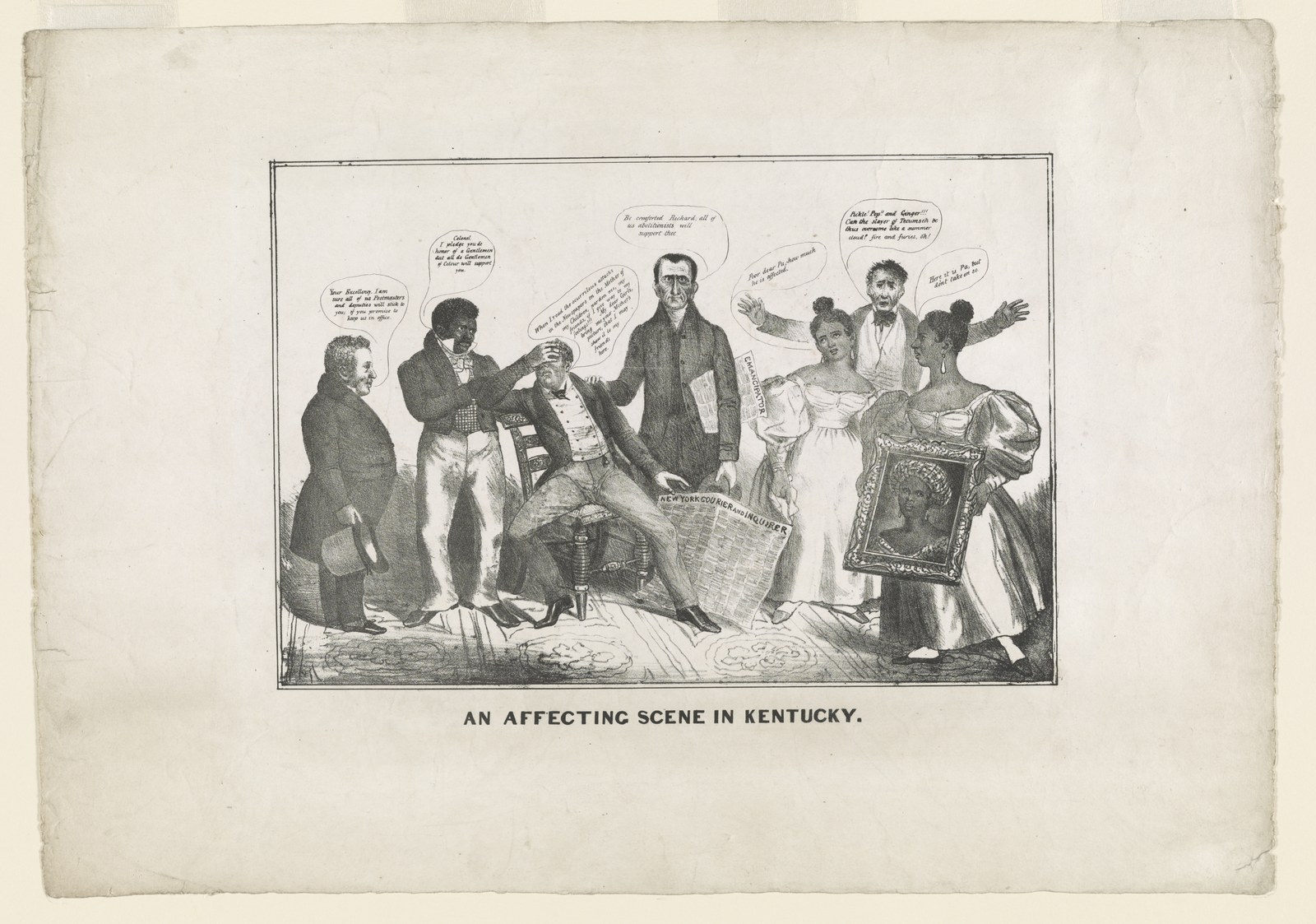
“An affecting scene in Kentucky,” 1836. A political cartoon mocking Kentucky congressman Richard M. Johnson, then a Democratic vice-presidential candidate, for his family with Julia Chinn and their daughters. It is not about Melungeons. It shows how a Kentucky family that crossed the color line was treated in national politics in the same years Tennessee and North Carolina took the vote from free people of color. Johnson County, Kentucky, formed in 1843, was named for him. Library of Congress, LC-DIG-ds-06474. Public domain. No known restrictions on publication. - 1830s–1850s Migration · North Carolina to the MidwestPaul Heinegg, who traced the free families of color of Virginia and North Carolina, writes that many “sold their land in the early nineteenth century and headed west,” which he thinks “was probably the consequence of a combination of deteriorating economic conditions and the restrictive ‘Free Negro Code’ laws.” Many who left “were enumerated in the 1840–1860 censuses of Indiana, Illinois, Ohio, and Michigan,” and some went to Canada. The best documented example is the Roberts Settlement in Indiana, founded in the 1830s mostly by families from Northampton County, North Carolina. In an 1830 letter, James Roberts warned a cousin against coming back south, where free Black families were, as he put it, “in between two fires.” These are free Black families, not Melungeons by name. Heinegg says their light-skinned descendants formed the mixed-ancestry communities of Tennessee, Kentucky, Ohio and other states.L8
- Prosecutions, lawsuits and moves, 1838–1875
- 1838 Court case · TennesseeIn State v. Claiborne, the Tennessee Supreme Court rules on a man indicted in Maury County under the 1831 law. He was a free person of color, “emancipated agreeably to the laws” of Kentucky, who had moved to Tennessee and stayed twenty days. The trial judge threw out the indictment. The Supreme Court reversed, holding that free Black people “are not citizens in the sense of the Constitution” and so the state could bar them. The case shows that Kentucky-born free people of color could be prosecuted in Tennessee for moving there.L9
- 1845–1848 Court case · TennesseeVoting trials in Hawkins County. After the August 1845 election, Vardy Collins and other men from the Newman’s Ridge and Blackwater families are indicted for voting while “being disqualified to vote by the laws of this state on account of color.” Jack Goins found ten men charged. Collins’s case ended on 25 May 1847 when the state dropped the prosecution and Timothy Williams stood security for the fine and costs. On 29 January 1848 a jury found Wiatt Collins not guilty and the state dropped the charges against Solomon, Levi, Ezekiel and Andrew Collins. A second jury found Zachariah Minor not guilty, and the charges against his brother Lewis Minor were dropped. Col. John Netherland defended the men. Two stories often repeated about these trials are not supported by the records Goins and Gross examined: that a jury judged the men by their feet (Goins did not find Netherland’s argument and does not think it was about feet), and that Netherland won the Melungeons the vote in 1859 (Gross found no record of a case that year). The 1897 Paducah Daily Sun story below describes the same fight over the vote.L10
- 1850 Law · KentuckyKentucky’s new constitution tells the legislature to pass laws making it a felony for “any free negro or mulatto hereafter immigrating to” the state, or for any freed slave who refuses to leave or comes back, “punished by confinement in the penitentiary.” The statute passed at the November 1850 session set the penalty at up to five years for any free Black person who moved to Kentucky “with the intention of remaining” after 11 June 1850. Visitors had to get a certificate from the county court clerk allowing a stay of no more than thirty days. It applied to free people of color moving in from other states.L11
- September 1852 Court case · TennesseeA Hawkins County grand jury charges Ambrose Hopkins, “a free man of color” not native to the county, who had come “from an adjoining state” about January 1845 and had been told more than twenty days earlier to leave the county and the state. The charge rests on the 1831 law. Goins reports that Hopkins did not leave Tennessee. His wife sued him for divorce in 1873.L12
- 1852–1855 Court case · TennesseeMarriage law is used against a Melungeon family. On 1 November 1852 James Bloomer stopped John Minor on a Hawkins County road, held an open knife at him and demanded a marriage license he suspected Minor of carrying for his brother Wilson, who wanted to marry Bloomer’s niece. Bloomer offered to prove that the Minors were “free persons of color within the degrees prohibited by the statute from intermarrying with white persons.” The trial judge refused to hear it. Bloomer was convicted of assault and fined one cent. In Bloomer v. State (1855) the Tennessee Supreme Court affirmed, saying that even if the facts were true they would not justify an assault. The court did not decide whether the Minors were free persons of color. Wilson Minor sued Bloomer and others in 1855 for false imprisonment, asking $5,000. Goins says it is the last record he found of Wilson.L13
- July 1858 Court case · TennesseePerkins v. White, Johnson County. Jacob F. Perkins sues John R. White, James Dugger and others over their statements that the Perkins family could not do business in the county and should be indicted for living with their white wives, because they were “Negroes.” The judge tells the jury that under Tennessee law a person with one-eighth or more African or Indian ancestry is a free person of color, and the jury sides with the defendants. Joshua Perkins, the plaintiff’s father and one of the county’s largest landowners, was still listed as white in the 1860 census. No appeal has been found. Some sources date the case to 1855 and Carter County; the attorney’s trial notes and Heinegg give July 1858 and Johnson County.L14
- 1858 Court case · TennesseeElijah Goin of Claiborne County wins $50 in a slander suit against Sterling Mayes (spelled Mayser in one account), who had told people the Goins were “mulattos and negroes.” A witness said Mayes had sung a song about Goin “being a little blacker,” and that he told his children to call the Goin children mulattoes and promised to protect them in it. According to Estes and co-authors, the Tennessee Supreme Court later reversed the verdict because it was commonly known in the community that the Goins were of mixed blood. We have not read the appeal opinion itself.L15
- From about 1860 Migration · Kentucky to OhioEdward Price’s 1950 study finds ancestors of the mixed-ancestry families of Magoffin County, Kentucky, in Floyd County (which then included Magoffin) by 1810, listed as free colored in 1820 and as both white and mulatto from 1850. Beginning about the Civil War, he writes, Magoffin County became “the jumping-off place for a move across the Ohio” to Carmel, in Highland County, Ohio. Price puts the move down to the general emigration from overcrowded parts of Kentucky. He guesses that darker-skinned members “may have found fewer opportunities at home,” but he does not say the families left because of a law or a prosecution.L16
- 5 June 1867 Court case · KentuckyIn Bowlin v. Commonwealth the Kentucky Court of Appeals reverses a white man’s larceny conviction because the main witness, George Gardner, was a free Black man. Kentucky law allowed “a slave, negro, or Indian” to testify only in cases involving other Black or Indian people. The court holds that Congress’s Civil Rights Act of 1866 cannot change this. Kentucky did not equalize testimony rights until 1872. For a family classed as “negro,” this meant its testimony could not be used against a white person.L17
- 1870 Law · TennesseeTennessee’s new constitution bans marriage, or living together as husband and wife, between white persons and Black people or “persons of mixed blood, descended from a negro to the third generation inclusive” (Article XI, section 14). It also says no school the state establishes or aids “shall allow white and negro children to be received as scholars together” (section 12). The sources we found do not show how Hancock County applied these sections to Melungeon families.L18
- 1874–1875 Court case · TennesseeThe “Shepherd case” in Hamilton County, Chattanooga. Relatives of Jerome Simmerman try to keep his daughter Martha from inheriting his estate by arguing that her mother, Jemima Bolton, had African ancestry and the 1856 marriage was void. Witnesses were asked whether Martha’s grandfather, Solomon Bolton, had voted and testified in court against white people. Chancery Court ruled that the marriage was lawful, that Jemima “was not of mixed African or negro blood within the third generation inclusive,” and that Martha was the only living heir. Her young lawyer, Lewis Shepherd, later wrote that he argued the family descended from ancient Phoenicians. The case is known as Jack v. Foust; the name “Simmerman v. Bolton” seen online does not match the court record. Shepherd remembered the year as 1872, but the surviving papers date the testimony 1874 and the decree November 1875.L19
- Wire stories from Tennessee
- 1 May 1895 · The Climax, Richmond Kentucky newspaperRichmond’s paper reprinted a piece from the Cincinnati Enquirer headed “THE MELUNGEONS,” quoting R. C. Borden of Asheville. He said they “came to east Tennessee from North Carolina more than a century ago” and that “Their names are of Portuguese origin and their appearance suggests an admixture of Portuguese and Indian blood. They have been classed with negroes, but it is easily demonstrated that they are not of negro origin.” The same piece called them “filthy and ignorant” and guessed they descended from an ancient people and “Portugese sailors.” It is the earliest use of the word we found in a Kentucky paper. Its insults and its Portuguese theory were both typical of the period.1
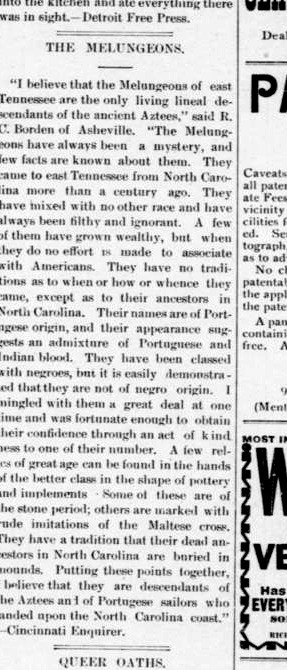
“THE MELUNGEONS,” The Climax (Richmond, Ky.), 1 May 1895, page 4, attributed to R. C. Borden and the Cincinnati Enquirer. This is the earliest use of the word found so far in a Kentucky paper. Library of Congress, Chronicling America. Public domain. - 23 March 1897 · Paducah Daily Sun Kentucky newspaperUnder the headline “THE MALUNGEONS,” a story about the community in Hancock County, Tennessee, “just across the Kentucky line,” reported that before the Civil War they “had a hard time in obtaining the right to vote and to send their children to the public schools.” The white citizens called them negroes, “and the matter was finally carried into the courts.” The families “declared on the witness stand that there was not a drop of negro blood in their veins, and after long and tedious litigation they were allowed to vote and to send their children to the schools.” The story adds that they sided with the Union in the Civil War. It shows how much a racial label could cost a family: claiming a Portuguese origin was a way to keep the vote and the schoolhouse.2
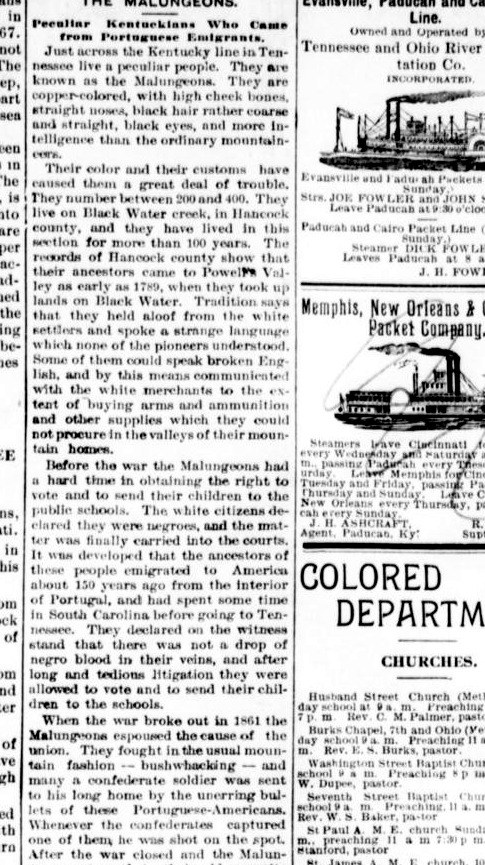
“THE MALUNGEONS. Peculiar Kentuckians Who Came from Portuguese Emigrants,” The Paducah Daily Sun, 23 March 1897, page 3. The article is about the Hancock County, Tennessee, community “just across the Kentucky line,” including the fight over the vote and the public schools. Library of Congress, Chronicling America. Public domain. - Other labels in the Big Sandy papers
- 1898–1910 · Big Sandy News, Louisa Kentucky newspaperThe word Melungeon never appears, but other labels do. In 1898 a Clay County feud story said Tom Marcum “traced his descent through Capt. William Strong back to the Indian girl” who married an Irishman, Tom Callahan.3 In 1902 a crime item called a man “a mulatto formerly of this place.”4 In 1910 the paper reprinted a Pikeville report, “No Negroes Need Apply,” adding: “We admire Prestonsburg and Paintsville: they have no negroes, nor do they want any.”5
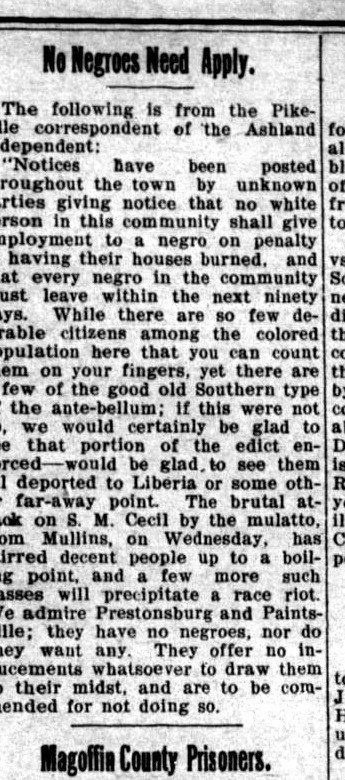
“No Negroes Need Apply,” The Big Sandy News (Louisa, Ky.), 4 March 1910, page 1, including the line admiring Prestonsburg and Paintsville. Library of Congress, Chronicling America. Public domain. - 1880–1965 · Johnson County papers Kentucky newspaperA search of every digitized Johnson County paper from 1880 to 1965 for Melungeon, Melungeons, Malungeon, Malungeons and Melungin found no matches. No local item applied “mulatto,” “Indian” or “Portuguese” to a named Johnson County family.6 The silence fits a time when families kept such ancestry quiet.
- Segregation and racial classification, 1904–1943
- 1904–1908 Law · KentuckyOn 22 March 1904 Kentucky makes it “unlawful for any person, corporation, or association of persons to maintain or operate any college, school, or institution where persons of the white and negro races are both received as pupils for instruction,” with a $1,000 fine. Berea College in Madison County was indicted that October. On 9 November 1908 the U.S. Supreme Court upheld the law as applied to the college in Berea College v. Kentucky. The sources we read do not say how the law affected children from families classed as mulatto or Indian.L20
- 27 October 1915 Court case · North CarolinaThe North Carolina Supreme Court affirms a judgment for the Goins family, whose ancestors had lived in Cumberland County, North Carolina, and then in Sumter County, South Carolina. Trustees of the Cherokee Normal School at Pembroke, in Robeson County, had refused their children, arguing the children “are of negro blood within the prohibited degree” and were not Croatan Indians. A jury found for the families. Estes and co-authors quote a minister’s testimony that “on the mother’s side plaintiffs are Indians and on the father’s they are malungeans.” Goins is also a core Melungeon surname in Hancock County.L21
- 20 March 1924 Law · VirginiaVirginia passes the Racial Integrity Act. The state registrar may prepare a form on which a person certifies his or her racial makeup, and knowingly making a false certificate as to “color or race” is a felony. A marriage clerk must hold back a license if there is reason to doubt an applicant is white. A white person may marry only another white person or a person with “no other admixture of blood than white and American Indian.” A “white person” is one with “no trace whatsoever of any blood other than Caucasian,” except that a person with one-sixteenth or less Indian ancestry and no other non-white ancestry also counts as white.L22
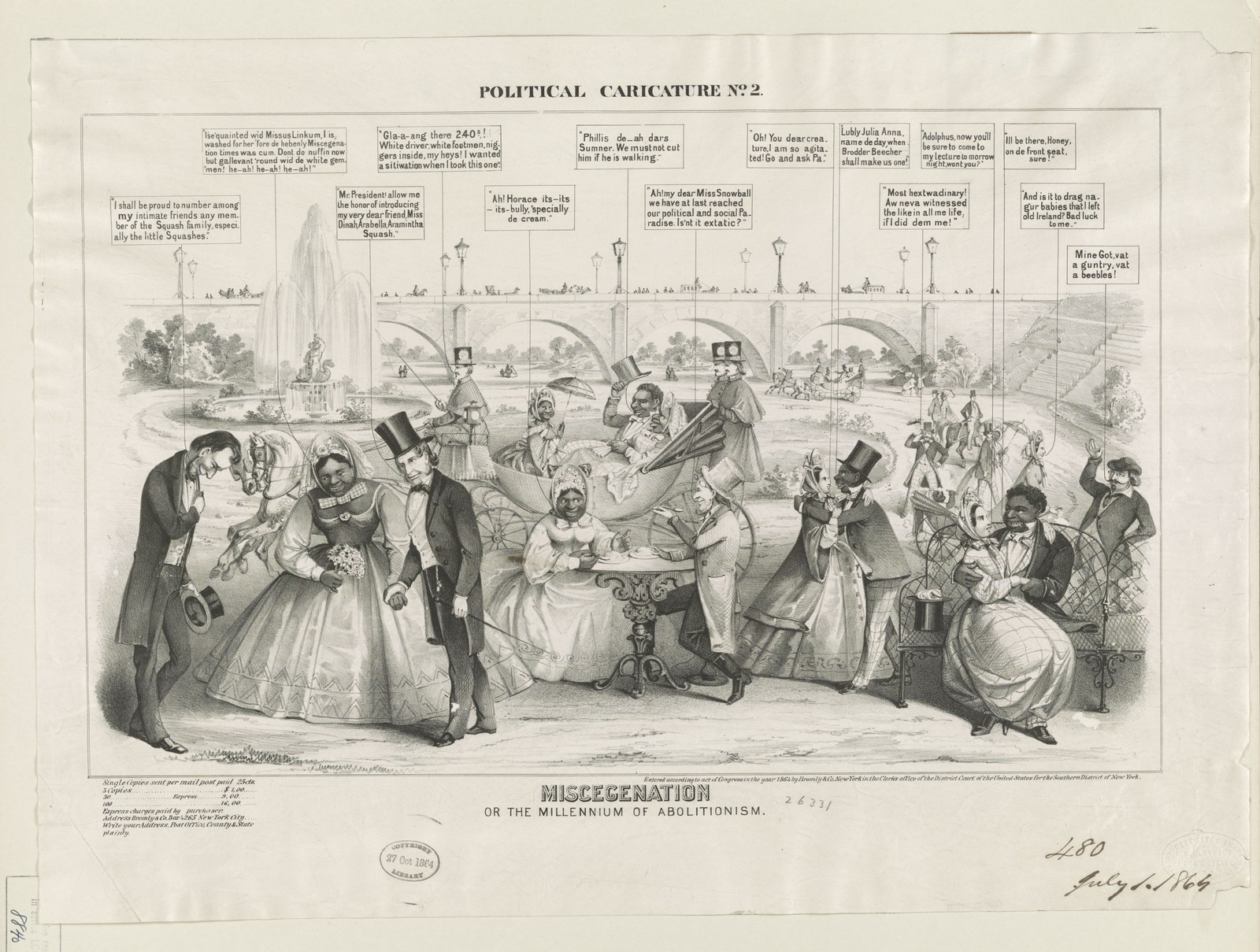
G. W. Bromley & Co., New York, 1864. “Political caricature. No. 2, Miscegenation or the millennium of abolitionism.” A Civil War–era propaganda print that played on Northern fears of interracial marriage. The Library of Congress notes that it shows Charles Sumner presenting a Black woman to Abraham Lincoln. It is not about Melungeons. Prints like this fed later campaigns for laws such as Virginia’s Racial Integrity Act of 1924, described in this entry. Library of Congress, LC-DIG-ds-06475. Public domain. No known restrictions on publication. - 20 August 1942 Registrar’s letter · VirginiaWalter A. Plecker, Virginia’s state registrar, writes to the Tennessee state librarian that his office is “particularly interested in tracing back, as far as possible, to their ultimate origin the Melungeons of the Newman’s Ridge section, especially as enumerated in the free Negro list by counties of the states in the U. S. 1830 census.” He lists 1830 Hawkins County heads of household, including Solomon Collins, Vardy Collins and Zachariah Minor. Jack Goins, a descendant, writes that several of his Minor and Goins relatives began leaving Hancock County about 1920 and that this led Plecker to search for them in Virginia. The letter itself does not say that. We have the letter only as Goins transcribed it.L23
- December 1943 Registrar’s letter · VirginiaPlecker sends registrars, clerks and legislators a list of “Mixed Negroid Virginia Families Striving to Pass as Indian or White.” For Lee and Smyth Counties he lists Collins, Gibson (Gipson), Moore, Goins, Ramsey, Delph, Bunch, Freeman, Mise, Barlow, Bolden (Bolin), Mullins and Hawkins, with the note “Chiefly Tennessee ‘Melungeons.’” Wise County, which borders Kentucky, is told to see the Lee, Smyth, Scott and Russell lists. His covering letter says such families demand “admission into white schools, forbidden by the State Constitution,” and that no Virginia descendant claiming to be Indian is “unmixed with negro blood.” The Library of Virginia says Plecker told officials that families on such lists were not to be listed as white in any record.L24
- Looking back
- 4 October 1961 · Paintsville Herald Kentucky newspaperA county history series counted 19 free people of color in Johnson County in 1860 and said “Some of these free negroes had migrated from the south.” See Free people of color in Johnson County, 1860.7
- 10 November 1965 · Paintsville Herald Kentucky newspaperA memoir of an 1890s schoolyard recorded children learning “Indian counting from each other.” See Schoolyard rhymes and stories.8
- The name returns
- 18 January 2002 · Paintsville Herald Kentucky newspaperThe first use of the word we found in a Johnson County paper is a library notice. Among the Johnson County Public Library’s new titles: “MELUNGEON COLONY NEWMAN’S RIDGE by Jim Calihan. The much-maligned people called Melungeons.” The phrase “much-maligned” marks the change: the paper now wrote about the prejudice rather than repeating it.9
- 14 September 2018 · Paintsville Herald Kentucky newspaperIn a preview of a genealogy conference in Paintsville: “Dr. Terry Mullins will give a talk in the afternoon about the Melungeon people.” More than a century after the word first reached a Kentucky paper as a curiosity, it was on the program of a local history day.10
Do you have a Kentucky clipping that mentions Melungeons, or a family scrapbook story? Send a photo and the paper’s name and date to [email protected].
Newspaper quotations on this page were transcribed from the scanned page images and their OCR text, with obvious scanning errors corrected. Follow each link to read the original page.
Related pages: History & Timeline · The Williams family of Johnson County