Free people of color in Johnson County, 1860
On the eve of the Civil War, nineteen free people of color lived in Johnson County. Here is what a local history column said about them, set beside the census.
What the 1961 Paintsville Herald said
In 1961 the Paintsville Herald ran a long history of Johnson County as a weekly series. The installment of 4 October 1961, under the chapter heading “Prelude to War,” counted the county’s Black residents before the Civil War:
“The 30 negroes among Johnson County’s 1850 population of 3,873, were all slaves. By 1860, the overall population had grown to 5,306 including 46 negroes. But of these negroes, only 27 were slaves and 19 were freemen. Some of these free negroes had migrated from the south.”Paintsville Herald, 4 October 1961, p. 71
The column then quoted the county’s own court records:
“October Term, 1856. Johnson County Court of Claims: To John Matney for arresting and whipping some runaway slaves—$3.00. To Martin Franklin, D. S., for arresting a free negro woman and summoning three witnesses and whipping same—$2.00.”Paintsville Herald, 4 October 1961, p. 7, quoting the Johnson County Court of Claims1
The woman’s name is not given. Being free did not protect her: a deputy sheriff was paid to arrest and whip her. The original order book entry, held by the Johnson County Clerk in Paintsville, may name her.
The column also printed a deed of freedom signed at Paintsville on 1 July 1860, in which John Stafford, “being old and infirm and desiring to free my black boy, Gabrielle,” gave him “the power to act for himself in every respect, either to stay in Kentucky or to go to a free state.”1
The census counts
The Notable Kentucky African Americans Database at the University of Kentucky compiled the 1850 and 1860 slave schedules and the 1870 census for Johnson County. Its figures match the 1961 column.2
| Year | 1961 Herald column | Census counts (NKAA) |
|---|---|---|
| 1850 | 30 Black residents, “all slaves”; county population 3,873 | 14 slave owners; 20 enslaved people listed as Black and 10 as mulatto (30 in all); no free Black or mulatto residents |
| 1860 | 46 Black residents: 27 enslaved and 19 free; county population 5,306 | 11 slave owners; 13 enslaved people listed as Black and 14 as mulatto (27 in all); 19 free people listed as mulatto, most with the surnames Dale or Spencer, plus 2 Blantons and 1 Collins |
| 1870 | — | 14 people listed as Black and 28 as mulatto, most with the surnames Right and Spencer |
So the nineteen people the column called “free negroes” were the nineteen free people the census taker wrote down as “mulatto.”
Why this matters for Melungeon history
Kentucky’s 1799 constitution gave the vote to free male citizens, “negroes, mulattoes, and Indians excepted.”3 A family’s label on the census could decide whether its men could vote. Labels also shifted from one census to the next. In 1870 the Johnson County census taker listed most of the Collins families on Jenny’s Creek as “Indian,” while the related families in Magoffin County were listed as “M” for mulatto.4
The one Collins among the free people of 1860 is worth following. Collins is one of the best-known Melungeon surnames. The Salyersville petition, which describes these families as part of an Indian community, says Joshua and David Collins, who came from the Greasy Rock (Sneedville, Tennessee) area, had acquired land on Jenny’s Creek by 1830, and that their wives were Elizabeth (Dale) Collins and Polly Ann (Dale) Collins.4 Dale was also the most common surname among the free people of color of 1860. Whether these are the same Dale and Collins families has not been established; that work remains to be done.
The label followed families into the twentieth century. Minnie Turner Williams of the Oil Springs Williams family, who died at Low Gap in 1911, was listed as “mulatto” by her husband on her 1911 death certificate, while the family Bible says she was born on an Indian reservation.
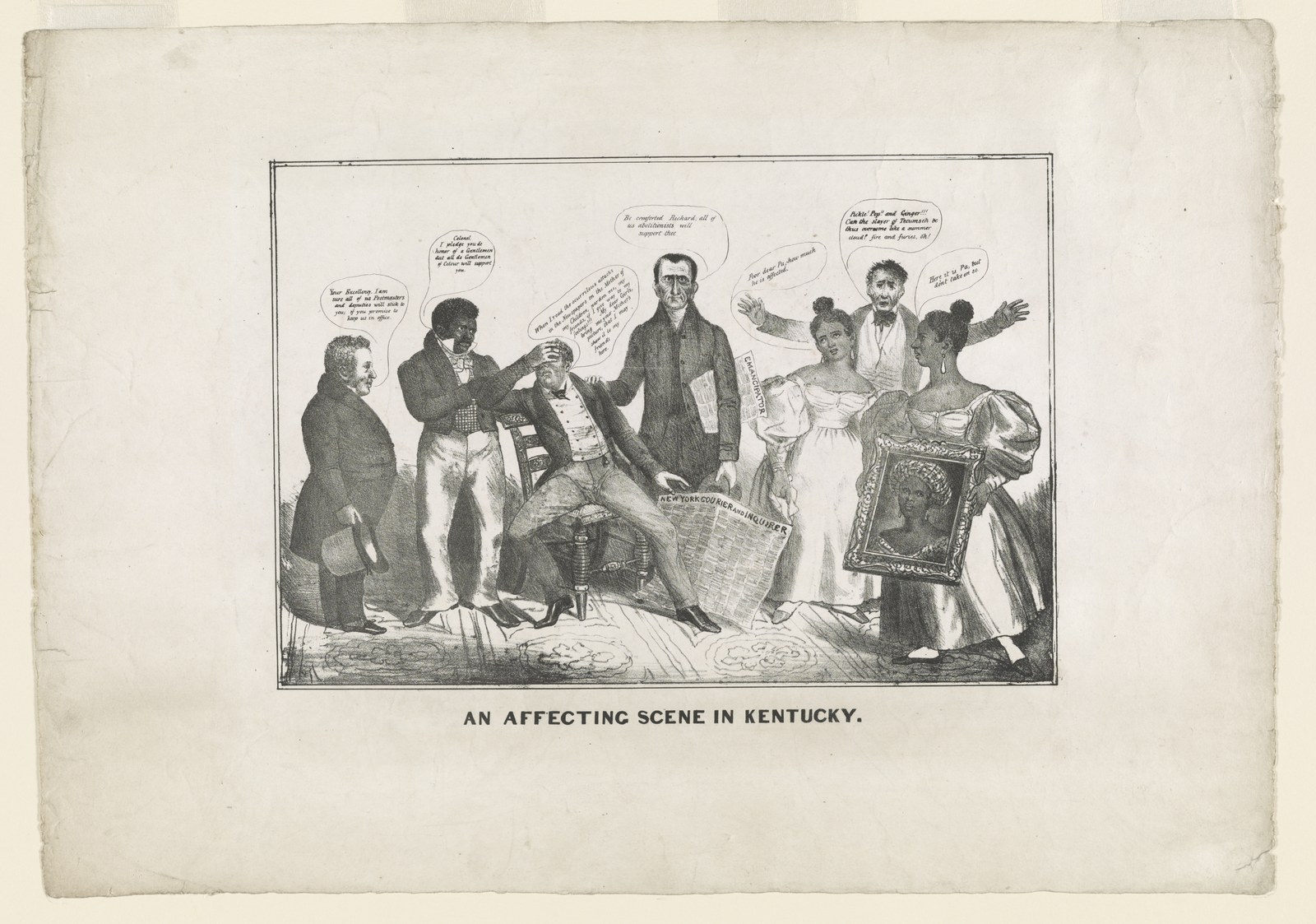
Johnson County itself, formed in 1843 from parts of Floyd, Lawrence and Morgan Counties, was named for Richard M. Johnson of Kentucky, a congressman and later vice president.6 In 1836, while he was a Democratic candidate for vice president, a political cartoon mocked him for his family with Julia Chinn. The print is not about the county’s free people of color, but it shows how a Kentucky family that crossed the color line was treated in national politics in the same years Tennessee and North Carolina took the vote from free people of color.
What came later
Fifty years on, the tone of the local papers had hardened. In 1910 the Big Sandy News reprinted a Pikeville report, under the headline “No Negroes Need Apply,” of notices ordering Black residents to leave within 90 days, and added: “We admire Prestonsburg and Paintsville: they have no negroes, nor do they want any.”5 That climate helps explain why many mixed families in the Big Sandy country kept quiet about their ancestry.
Help us name them
If the Dale, Spencer, Blanton or Collins families of 1860 Johnson County are in your family tree, we would like to hear from you at [email protected].
Newspaper quotations on this page were transcribed from the scanned page images and their OCR text, with obvious scanning errors corrected. Follow each link to read the original page.
Related pages: Kenwood and Low Gap · How Kentucky newspapers wrote about Melungeons · The Williams family of Johnson County